Sunday, August 23, 2009

The Simpsons......Game?--A Review of America's Favorite Disfunctional Family

While it's been over twenty years since we were introduced to the new found exclamation of "Do'h" and informed that we should take care not to own a bovine creature, man, it's sadly been almost that long since we've seen a good Simpsons video game. Understandably, the only great titles were those that firmly latched onto the coattails of "tried and true" game series/mechanics. The Simpsons the arcade title was a downright addictive experience, but never strayed from the Konami 4-player arcade formula established in such other titles as X-Men and Teenage Mutant Ninja Turles. Radical Entertainment's highly successful Simpsons: Hit and Run, which sold over three million copies, was essentially a careful transformation of Springfield into a Liberty City/Vice City/ San Andreas of sorts. Like most media enterprises that tend to start outside of the video game realm, the only way in comes in the form of a preexisting template.


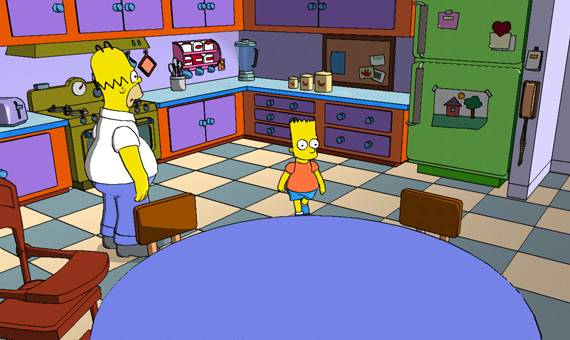
Feel free to wander around the house. The camera angles that greet you will have you heading for the front door in no time.

Unfortunately, because the Simpsons were one of the preeminent franchises of the 90s, and, while diminished, remain a strong force to this day, the pressure to flood the market with all sorts of dolls, games, toys, etc regardless of quality happened all too fast. Soon Nintendo titles hinged on such flimsy ideas as Bartman, Virtual Bart, and the Treehouse of Horror episodes. And let's not even talk about Bart Vs. The World. But things have changed, EA has now been entrusted with the house that Matt Groening built, and put their hefty pocketbooks behind a truly new adventure for Homer and the gang, a belated tie-in to the also quite self-explanatory film The Simpsons Movie.

Let's start with what shouldn't surprise us, from our past dealings with EA and The Simpsons. As par usual, EA has more than sufficiently flooded the project with cash, and got Groening's staff to provide the game with over forty five minutes of animation, on par with that of the tv show, as well as scribing the tale itself. The collaboration between the two powerhouses is more than evident, from the voice acting to the frighteningly perfect reproduction of Springfield, to the more than frequent references to obscure episodes (like Mr. Sparkle, for example). The next-gen visuals are at a point where they rival the look of the animated show itself. More or less, EA's got the presentation down pat, and taken great care to bring all of the aspects of The Simpsons to fruition in the title.

Here Bart and Lisa take on the logging efforts of Mr. Burns, and to paraphrase a certain South Park quote, "The Simpsons did it...already."

What's surprising (and by surprising, I mean "bad" surprising) begins first with the story. Instead of perhaps honing in on a specific person/aspect of the Simpsons universe, like most episodes do, or portioning the game into episodic self-contained bursts, The Simpsons Game has taken a new approach. Specifically, the Simpsons family is self-aware that they're in a video game; they find the manual to discover their moves, and look up a walkthrough on the Internet to discover what to do next. Isn't that funny? I mean, doesn't it have you in fits? Oh look, Will Wright and Matt Groening are in the game as themselves!!! Don't you love how they're self-consciously aware how stupid the idea of key cards are?

Is it funny, or sad? If one beats others in pointing out his/her own flaws does that forgive them in the first place?

While some games have truly been funny in their self-referential nature on gaming (like the funny, albeit flawed Eat Lead starring Max Hazzard) this smacks of an incessant self-conscious apology. As you go through the game, you'll be occasionally interrupted by the "Comic Book Guy" as he diminituively points out that you've once again encountered/enacted/found a "video game cliche," of which there are 31 to discover throughout the game. They vary from the protagonist not being able to swim, to the traditional pressure panels that require both party members, to the ubiquitous breakable crate. If these were mechanics were "one-liners" that we could dispense with after hearing, perhaps they'd be, dare-I-say-it, comical. But the truth is that these very elements they joke about are ever present and make up the majority of the gameplay.

The feebleness of the gameplay is masked by the ability to switch between the nuclear characters of the Simpsons family; freely in the hub world, and between the two pre-designated characters within the levels. Lots of characters mean lots of abilities and moves, right? Sure, if you're up for some fairly mundane abilities spread across four characters. Bart can glide with a Bartman cape, grapple to certain objects, and use zip-lines. That's right, you'll be familiar with Bart's "special powers" if you've encountered a ropes course at summer camp. Homer can burp on people to stun them, and roll around as a rotund version of himself. Lisa can play her sax loud enough...to stun people...and can pick up large objects with the power of...*sigh*...Buddhism. Marge can use a megaphone to...*yawn*...stun people, and can order crowds together to attack things. Many games would be completely comfortable with giving a singular playable character in a game this many abilities, were they not so trite and shallow, but the mediocrity is spread out in this one.

Bart can climb vines. Because, apparently, nobody else can. And, because, apparently, a cape and a mask easily assist one in said process. Ughh...sigh.

Most levels involve running around, finding collectibles to open doors, or breaking down a certain set of structures, or defeating a certain amount of enemies. Boss battles have a "rinse repeat" nature to them, once you've figured out the "secret" or "weak point" it is literally only a minute or two before you'll have destroyed it. And this begs a question: If a game is self-aware of its mediocrity in gameplay, or the over utilized tropes it plays around with, do we approach it with the same stance we would a game rushed to production, hoping its mediocrity will only be discovered once the shrink wrap and security tags are shed?

It provides us with another question as well: Is The Simpsons Game, in actuality, a game? With gameplay that is mindnumbingly repetitive (which is not to say that this is incapable of being enjoyed, aka, Marvel: Ultimate Alliance) and virtually no penality for death, along with perpetual solutions to already frighteningly easy puzzles provided in thought bubbles above the character's heads, are we actually playing a game? Or are we being pushed through a linear series of events, with an engineered impossibility of failure? Is this a predecessor to the recent eye candy that was Prince of Persia?

...speaking of the great choice-less adventure...

While the abovementioned paragraph seems to be littered with a handful of rhetorical questions, the answer to most is a resounding "Yes," and this appears to be a recent trend in the transformation of popular franchises into video games: basic, yet uncomplicated games, with basically no learning curve, and hardly any penalty for death, based on a preconstructed graphical engine. It's a "Choose Your Own Adventure" with the poor options taken out. You're given an accurate presentation of the desired franchise, and a storyline to match such, with no chance of not completing it.

While the review has taken a bit of a macroscopic stance on the implications of games that share a resemblance to The Simpsons Game, allow me to recap. The Simpsons Game is a well produced, and heavily funded title that relies more on fans "getting" soundbite references and meeting bit characters from the tv program, rather than focusing on innovative gameplay and/or an enjoyable story in line with the show. The storyline is too caught up in itself, and the subtlety of the show's humor (which was never that subtle) is completely lost with its meta-narrative. If you want a good looking Simpsons platformer riddled with basic fetch quests and a camera that will give you fits, the already low price should already encourage a purchase. If you simply have a Simpsons itch that you need to Scratch-y, you'd do better to simply get your hands on one of the earlier seasons on DVD.

Overall score 6/10
Good graphics and presentation
Bad Camera
Barely passable story
Poor gameplay

Wednesday, August 12, 2009

Whater ya playin'?

Welcome to what will likely be the first and only installment in the "Whater ya playin'" series. If that title seems odd...just imagine the merchant from Resident Evil 4 saying it. And if you haven't played Resident Evil 4, begone with thee!!! *Beckons toward the door* If you're wondering just what goes on in this series, the pithy statement "it is what it is" comes to mind. Leaning more towards the "stream of thought" style blogging is more known for, I'm simply going to write just what I've been playing lately, why I'm playing it, if I plan to keep playing it, and how I feel about it in general. This may branch out to sentiments regarding gaming in general, but I'm not certain at this point.

*Looking back over the past paragraph* Well, while that somewhat reeks of self-indulgence and a heightened level of self-importance, I'm going through with it. The last thing I want to add to that list is to have the qualities of a "quitter" as well.

What have I been playing, exactly? I've been occasionally dabbling in The Secret of Monkey Island: SE, for Xbox Live. Why do I say occasionally, you wonder (or not...if you happen to have a life that can successfully revolve and exist outside of knowing my every move). Because apparently you HAVE to have online access wherever you desire to play the game, as it requires logging into Xbox Live. I understand why, like, I totally get it. But that doesn't mean that it isn't a pain. I don't have any of the ethernet ports in my room, and I didn't shell out whatever ungodly amount for that expensive wi-fi receiver. That being said, I can only play when I'm at a friend's house. Perhaps it would be less of an issue if I actually had LIVE, but because I actually get my ass out of my house, I play with other people.

The only true "Secret of Monkey Island" is that you're going to need to have LIVE to download it...and to unlock it every time you play it.

Minor ranting aside, The Secret of Monkey Island is a perfect port of the original Lucasarts PC title. Well...it can be. You have the option at ANY time of freely switching between the original game and the HD makeover that its received. Please note the word "makeover." While this old boat's been given a new coat of paint, the gameplay, the puzzles, the dialogue, the storyline, all of it is intact...and untrammeled by developers that would be tempted to tweak things. I'll get into it more in a full scale review, but its safe to say this this, for ten dollars, is a bit of a steal. One of the best adventure games ever, intact in its original format, as well as the new look, and with all the dialogue fully voice, with the cast of The Curse of Monkey Island nonetheless.

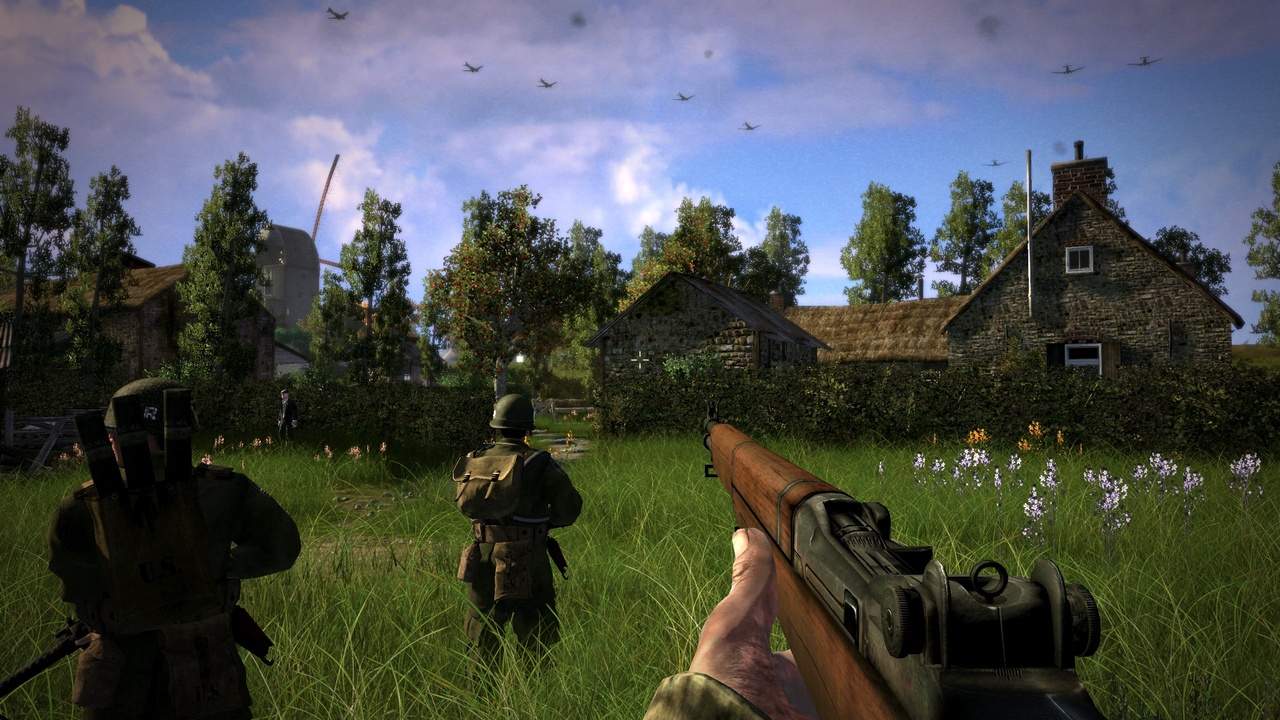
There's just a much more epic sense of scale and teamwork in Gearbox's title. Not to mention that one actually begins to care about their ally compatriots. Something that CoD and MoH have never been quite capable of capturing.

Other than that, I've been dabbling around with a much more large-scale, yet linear title: Brothers in Arms: Hell's Highway. If you haven't heard of it, the sheer flooding of the shooter market between the Medal of Honor and Call of Duty series have left little room for other series to inventively enter the genre. What I'm getting at is that there have been a couple affordable alternatives that are vastly inferior to the aforementioned franchises, but none have offered anything other than a poorly emulated experience, and most importantly, addressed the gaps and flaws that these two have presented. Specifically, Brothers in Arms offers an amazing story that isn't afraid to focus on the exploits of a single battalion/correct name for group of soldiers led by Matt Baker. You'll connect with each one of your squadmates, learn their fears and dreams, and see the effects of war on individuals even when they're not being peltered with mortar fire.

The gameplay is a bit of WWII meets Gears of War, with the grenade and cover mechanics looking eerily familiar. However, I find the cover system here to work a bit better, and is generally more responsive. The graphical engine is quite good, utilizing a modified variation of the Unreal Engine 3, and provides a semi-cartoonish/exaggerated style to the characters, making it easier to distungish who's who. The only problem I've encountered so far is that the story's strength hinges on one's knowledge of the two previous installments in the series. Apparently I'm visited several times by a ghost (or have nightmares of such, I'm not entirely sure WHAT he is at this point) of a long dead squadmate, but the importance of such relies on the knowledge of this character in previous games.

What's on the horizon? Looking at starting up Bionic Commando and maybe a couple rounds of Sid Meier's Civilization. But, more importantly, what are you playing?

Thursday, August 6, 2009

Battlefield Bad Company--A Review

Summary in a sentence: EA's D.I.C.E studios makes a remarkably competent foray into "single player campaign-land" with its new title, sporting a remarkable appetite for open-ended destruction...with a brand spankin' new graphical engine to boot.

During the summer of 2008, Electronic Arts bestowed upon a parched populous of gamers two seemingly similar titles. Indeed, it requires little imaginative skill to realize that Mercenaries 2 and Battlefield: Bad Company have a common upbringing in the "visit foreign country...get betrayed...seek revenge amidst a civil war, all while attempting to profiteer for one's own self off of said chaos and senseless destruction" genre. If this genre never truly catches on, I'll attribute it to the title of it. As it is in the crapshoot that is the video game industry, one turned out to be remarkably good, and the other...so-so. What's altogether surprising is that this conclusion turned the notion of "pedigree" on its head. Provided the notion of pedigree has a head. Or a metaphorical head.

The bottom line is that Mercenaries 2, the sequel to one of the very few "GTA clones...but not exactly GTA clones" to make a name for itself other than "shameless shoddy emulation" was based on a fairly strong freshmen entry that, with a few minor flaws fixed, stood to stand in strong contention with long-running franchises. Battlefield:Bad Company came from a long series of games that, like the creepy second cousin you occasionally run into at family reunions, never managed to truly fit into the console realm of gaming. It was far too dedicated to online play as its main purpose, as well as banking on a solid PC mods community, and, in general, never mapped well to console controllers, or ported well to consoles, in general.

*Cue Zelda chest opening tune: da-na---NAAAAAAA!*

At this point I could continue to creatively weave a narrative that would continue to perpetuate this notion that Battlefield: Bad Company was taking on an Olympian sized quest to topple the evil regime that is the Mercenaries franchise, which would turn out to conveniently eat babies and use aerosol cans, not for utilitarian purposes, but to further the spread of global warming. However, you're clever readers, and have already discerned that Battlefield: Bad Company was the better title of the two. Without any further ado, let's break it down.

The narrative of Battlefield: Bad Company treads the line perfectly, neither providing the player with an overwrought and heavy-handed melodrama reeking with self-indulgence, nor leaving the player with a one sentence justification in the manual for just why the act of widespread destruction and mayhem is ensuing. And it runs something like this, you are a soldier in the US military named Preston Marlowe, and without elaborating too much, you've happened to do something that doesn't go over well with the military-industrial complex. And rather than expel you, or perhaps put you on trial (though the past has shown that this hardly means anything) the army has its own "Remedial Regiment" reserved for the less than...exemplary models of the US Army. Appropriately, this group is called "Bad (B for short) Company."

Joining you are Private Sweetwater, who happened to upload a virus into the military's computer network, Private Haggard, a pyromaniac with a southern drawl that happened to set alight a fairly large ammo dump, and Sarge, whose done nothing wrong but was told his term of service would be shortened if he commanded the regiment with a disturbingly high turnover. While on your first mission you come across a member of a private military organization called "The Legionnaires" who happens to pay its members in gold bars.

A little explosion never hurt anyone. That's why you'll be causing BIG ones in this game.

Haggard, lured by the sweet promise of 24kt wealth runs after the trucks of "The Legionnaires" and, technically, invades a neutral country. Not wanting to have to answer for Haggard's temporary lack of judgement, Sarge orders your regiment to give chase. Explosions, more explosions, and a bevy of explosions follow. Cutscenes hardly provide one with a lengthy exposition on US military tactics, but they do provide likeable banter between your squadmates, and while all of them seem to fall into fairly common war film archetypes, it's enjoyable nonetheless.

The gameplay is fairly conventional and builds on the mechanics of previous installments, as well as conventional FPSs. You're allowed to carry a primary weapon (shotgun, assault rifle, sniper rifle, etc) a secondary firearm (more or less, variations on the theme of "pistol") and a special inventory item. There are a few twists though.

All primary weapons (and all are "real" weapons, used by various worldwide military and police organizations) come with a secondary function (underbarrel grenade launchers, for example) or allow for the use of grenades. The inventory accessory is what really mixes things up though, and allows for a decent amount of tactical customization. Need something to take out small tanks and pockets of infantry? There's a GPS transmitter that can call in mortar strikes. Want something more adept to taking on more heavily armed vehicles? Pick up a device that calls in a laser guided bomb, controlled by the player as it drops through the sky. Aching to repair your smoking helicoptor? There's a universal repair tool that'll do the job. And, of course, C4 is available as another one of these "gadgets." But you can only carry one at a time, until given the opportunity to swap out.

You've got a flaming slag that used to be a personnel carrier, Sarge looking on, and Haggard hoisting quite the armament. Care to guess just what exactly happened?

Those not used to the Battlefield series will find a few surprising changes on the FPS conventions. For starters, there are no health packs, instead, you have a adrenaline-esque shot that you are free to inject yourself with at any point, which returns your health back to a reassuring 100. Sound like a "game-breaker?" It's not. Because in Battlefield you die one way. Fast and frequently. Yet when you die, and return to the most recently reached checkpoint, all of the vehicles, soldiers, and inanimate destruction you had laid waste to on your previous "life" will remain exactly that...dead. It's an odd feeling, to say the least, to instinctually expect a tank around a corner, only to find a smouldering mess. In the end, you might be asking just what all of these oddities add up to, and the reality is this: a highly fast-paced explosion-fest that has no problem literally throwing you right into the middle of a full-on war, without the endless frustration that would accompany an entirely realistic approach.

The visuals of Bad Company are competently handled by the Frostbite Engine, recently created by D.I.C.E studios, and allow for an unbelievable amount of action to take place, without slowing down the framerate a bit. Visual fidelity has not been compromised for sheer speed, though. The character models are well animated and a semi-exaggerated cartoony flair in their creation breathes life into what is otherwise the "already been there and done that" that is modern warfare. However, it must be said that aside from blowing entry point holes into the sides of buildings, and simply leveling things, a greater amount of "tactical chaos" would be appreciated.

"Or I'll huff...and I'll puff...and I'll...fuck it, let's just use the mounted grenade launcher."

The music is strikingly epic and adventuresome without, like the story, getting too full of itself. It's aware that it's a sandbox roam-around in search of treasure. Likewise, the voice actors take care to never present their roles as anything but that. Sarge is constantly peeved with the morons he's now taken charge of, Sweetwater comes across as the geeky intellectual that just happened to press the "ENTER" button at the wrong time, and Haggard...well...he's the idiot savant that has none of the qualities of the latter.

Think of it as the "Remote Control of Death." Just point, click, and instead of switching to Animal Planet, set loose a flurry of mortar strikes. Which is not to say that Animal Planet isn't exciting, but...

Overall, if you want an excellent modern warfare campaign with a very different mood and disposition than CoD4 this is it. If you were looking for D.I.C.E. to finally put a bearable and light story to its large-scale battles, this is that as well. Hell, if you're looking for a generally flat-out amazing, as well as affordable (20 dollars, mind you) title, and you aren't morally opposed to First Person Shooters, this is for you.

Friday, June 19, 2009

Mirror's Edge: An Exercise In Innovation

I recognize that by saying that I thoroughly enjoyed Mirror's Edge, with few issues and exceptions, I am somewhat in the minority. Few individuals extensively trashed it, but...well, hmm...as much as I hate to use numbers and other quantifiable methods for something I'd otherwise deem unquantifiable, most people probably ranked this game between 70 and 80 percent. I'd probably put it around 90%, right around my stance on Mass Effect. Above all, the game's length and "trial-and-error" play style are slightly problematic, but we'll touch on these later on.

Let us begin with the story, something mostly uninteresting and only lending the gameplay a flimsy mechanic to work with. You're a Runner named Faith, an individual tasked with carrying messages and transmissions across the rooftops of a totalitarian state, where all other forms of communication (radio, satellite, television) are heavily monitored to the extent that we've found ourselves in a situation comporable to a modern day reenactment of Marathon. As with carrier pigeons, often the oldest technology proves to be the most reliable. As with most games involving a totalitarian state (not including, say, Overlord...and I'm still waiting for the video game of 1984) runners are involved with the "underdog" movement, carrying messages for the opposition, in favor of a mayoral candidate that promises to bring change.

The story is so boring, or, perhaps insignificant, that let's just call this individual "Harvey Dent." As one might suppose, Harvey's attempt to bring "power to the people" isn't about to go unopposed. To save another five to ten minutes of boring exposition, there's a couple people in the police dept that support this candidate, under one of which Faith's sister works. Guess what? In the vein of most video games, the Princess/Pe'j/the President's daughter Ashley/ your sister is captured.

And guess what? Now the whole issue is "personal." Surprise, surprise. And you'll spend the remainder of the game attempting to clear her name.

What you will care about is the gameplay and the lovely aesthetics that Mirror's Edge has to offer. For those who like to read reviews of products of which they have next to no previous knowledge about the product being evaluated, Mirror's Edge is a first-person title that *gasp* isn't a shooter. In fact, it's...*drum roll* a platformer!!! Granted, this idea is not utterly foreign, one only needs to look at the majority of FPSs that have offered some mild platforming sequences to see that it has been done before. However, this is usually the ubiquitious criticism found in all these titles, not only the creation of the platforming elements, but the refusal to revert to third-person when confronting them.

So...effectively...Mirror's Edge is the full-fledged effort to create an entire game centered around a genre/niche/perspective that has often been the game development "kryptonite" of other titles. A comporable equivalent would be a game that is made up of one giant "fetch-quest" (this is not to say that such a feat has not been attempted several times). To say Mirror's Edge is basic platforming however, would be to make the same claim of the wonderful Prince of Persia series...a generalized mistake. Specifically, the game hones in on the parkour scene, or "freerunning" as it is otherwise known. This involves flips, jumps, leaps, and other acrobatics strung together, and usually performed in an urban setting where one has props (bars, building edges, etc...) to interact with.

The core elements to success in Mirror's Edge are accuracy and momentum...closely followed by balance. One must smoothly chain together sliding under water pipes, jumping onto adjacent ledges, and climbing poles in such a fashion that one hardly finds oneself coming to a "dead halt." Indeed, most of the games actions and elements cannot be approached without some degree of built-up speed or momentum. Indeed, the moments where one can stop and grasp a feel of one's surroundings are few and far in between. Linger too long at many moments, and you'll give the mounting police forces something to put in their sights. The only instances where this isn't the case are the blatantly puzzle sequences that depart outright from the free-running sequences. Sometimes you'll be tasked with a semi-puzzling sequence while on the run, and at said points, expect to die...a lot. Sometimes this will result from haphazard leaps of...pardon the pun...Faith, while others will involve a slew of bullets being hefted in your direction.

While there are few enjoyable feelings as great as expertly navigating a course on time trial mode, the antithesis can be said of one's first play through an area. Trial and Error, the "plug-and-chug" twins of slovenly gameplay are ever-present in Mirror's Edge. Many times you'll approach a jump with absolutely no idea of the outcome, reassured only by the "Runner vision" highlighted in bright red. However, this tends to show up less and less toward the latter levels, as the developers assume you can pick out the items (ramps, pipes, climbable fences) from the remaining inconsequential set pieces. Occasionally you'll be asked to "get creative" when dealing with a *SPOILERS* train and a helicoptor *SPOILERS DONE* but otherwise, expect to stick to your bag of tricks.

Aesthetically, D.I.C.E.'s skyrise platformer is equally technically proficient as well as artistically inspired. Character models are slightly less detailed than the environments, but considering that you'll spend of the time with people chasing after you, this is inconsequential. Most of the face-to-face interactions are handled in the cutscenes, which will be discussed briefly. The first person view is expertly accompanied by vision blurring and depth of field effects that only heighten the feeling that you are truly seeing things through Faith's own eyes. You'll spend a lot of time staring at her hands and feet, so these are well detailed. However, it is the artistic style utilized that really shines. All surfaces are either excessively shiny, reflective, and clean, or painted a solid and bright color. Effectively, it's a town of shiny windows, and whitewashed clean buildings, occasionally highlighted by blocks of neon shades. It's what every totalitarian/seeming utopia should look like. Crisp. Clean. And doused in red wherever you're suppose to interact in the interest of subverting it. If you want avoid a coup, (facist dictators take heed) don't allow anything to be painted red. It will ultimately be your undoing.

The voice acting is functional, but not stand-out, and the sound effects are sparse, but perfectly capture the moves and pacing and momentum of Faith. The soundtrack, however, is probably the best of the year, and a likely contender for the best soundtrack in a game ever. It is ambient wonderfulness at its best, which picks up to a buzzing Electronica pace when confronted with a...time-sensitive or combat oriented scenario.

Overall, Mirror's Edge is an attempt at innovation, and while this should not force us to give it a "pity grade curve," perhaps one should recognize these risks taken to achieve the positive aspects, the newfound ideas that Mirror's Edge manages to pull off well. After all, if we cannot promote innovation at the outset of a franchise, no matter how infantile or imperfect it may be, it'll never live to see itself fine tuned.

Monday, May 11, 2009

Resident Evil 5: Proudly Not Fixing What It Doesn't Think Is Broken

Somehow attempting to "blend in" strikes me as a somewhat futile gesture, when you happen to be the only white person in the village.

Unlike the majority of my reviews, allow me to start this with a fairly straightforward statement: If you enjoyed Resident Evil 4, and wouldn't mind playing the game over again, with an extra layer of graphical polish and a different set of characters, play Resident Evil 5. On the other hand, if you spent the last four years expecting this installment to be a fundamental quantum shift...a truly "next-gen" experience, a weekend rental might be more apt.

And this, dear friends, is why we won't be returning to Raccoon City for this installment in the Resident Evil series. Unless you're playing one of the Wii's rail-shooter installments. In which case, Raccoon City still exists. Because Capcom needs money. More money so they can release another 75.3 more Megaman games this year. MOAR teh Megamans!

Throughout the Resident Evil franchise we've encountered zombies in a mansion, zombies in Raccoon City, zombies on a train, and pretty soon we we having to traverse over to Spain, and currently Africa, to get our zombie kicks. Ever since we nuked Raccoon City and promptly said goodbye to any chance of an undead revival there, Capcom has scoured the bottom of their storyline bin for excuses to look outside this. In Code Veronica we had Claire hunting down her brother on Rockfort Island and in the Antarctic. In Resident Evil 4, Leon was looking for the President of the United State's daughter. In this most recent installment, Chris Redfield still has questions about the supposed death of his old partner, Jill Valentine. Apparently the Resident Evil series is now reduced to the disappearance of relatives/friends, and investigating mysterious deaths for plot points. Not that story has ever been a strength for the decidedly hammy B-movie vibe of a franchise.

With that in mind, there's not much to say about the story period. Chris is sent to Africa as part of the Bioterrorism Security Assessment Alliance to investigate a man by the name of Irving who is supposedly attempting to sell...guess what...SPOILERS....a biological weapon on the black market. Of course, he's working for one company called Tricell, who happens to be in cahoots with SURPRISE, SURPRISE, Umbrella. Of course, several things always happen to come neatly packaged with Umbrella: mutated and rage-filled humans, mutated dogs, and other genetically engineered freaks of nature. And yes, Wesker also happens to be along for the ride. It's a paper-thin plot that does its job of providing interesting set pieces and massive adrenaline explosions, but doesn't necessairly have you wondering "whodunit" at the end of the night.

Wesker is still alive, Umbrella still exists, oh, and the new evil biochemical company, Tricell, actually in cahoots with Umbrella. So...just what WAS accomplished in the past RE games?

Gameplay wise, I have to hand it to Capcom. When you choose to change so few...so very, very few aspects of the gameplay, why do you break the things that work, or alternately, apply the changes that people spent several years clamoring for? Let us begin with the addition of Sheva. It's an odd move, considering that after having to put up with Ashely, most gamers really wouldn't want an assistant in any capacity. But hey, Ashley got out of your way when you had to shoot someone, and didn't steal/waste your supplies. What does Sheva do for you? Well...to begin with, she severely expedites the collection of items. Move too slowly in scouting a room, and she's likely to dig into the spoils herself. Now this is just a minor (though after a while there's nothing minor about it) annoyance, but if you don't take heed she'll begin an item "spending spree," especially if left with your healing herbs. Again, this would be alright if she was a "support" character, providing cover fire and healing you when only absolutely necessary, in order to optimize the herb's healing capabilities. Sheva, however will douse you in a torrential downpour of first aid spray if you so much as scratch your shoulder or attain a papercut.

On the other hand, if you happen to think that Sheva is a "big girl" and can hold her own, handing her the heavy weapons (the magnum, grenade launcher, or rocket launcher) is likely to elicit a befuddled "me, what?" response. Despite leaving her with all sorts of high end weapons and gadgetry, she continued to look at me as if I had just asked her to run into combat with a cap gun. Correction: she would probably have at least figured out how to fire the cap gun. The truth lies in the fact that Sheva was brought into the picture for several reasons. Firstly, it allowed for a character that didn't "come out of nowhere" to be utilized as a possible "Player 2" during co-op mode.

Secondly, it allowed for Capcom to proudly claim that, unlike any of its previous entries (save the dreaded Outbreak series) that their newest Resident Evil title had online play going for it. Sadly, for many gamers, if a game will not embrace the online world in any capacity, there's just no chance it will be picked up. There have been exceptions, like Bioshock, but this rule holds true for many. Finally, Sheva was utilized to avoid claims that Resident Evil 5 wasn't a "racist" game. Unfortunately (and this would honestly merit another essay in its own right) Sheva only worsens the post-colonial attitude that the title already enforces, throwing in a pinch of misogny and racism for good measure.

At this point Sheva is: A. Reloading her gun. B. Shouting that she needs you to cover her C. Wasting your healing herbs D. Wandering off on her merry own E. All of the Above

Let it be said that aiming for an exemplary model of "ally artificial intelligence" is commendable, and many games like Prince of Persia have offered their own attempt at such an ideal as of late. Is that what we have been handed with Resident Evil 5? Not at all. We've been handed, for all intents and purposes, an intolerable stand-in for what would otherwise be controlled by a human. Either create a new storyline that props up when we play co-op, (it doesn't have to be award winning, but some plausible excuse for introducing the new character) or let us "go solo" in single player, or simply fix the ally A.I. These are your options, Capcom. Let's try not to stray outside of them next time.

Solid Snake, Rambo, Mario (fuck Luigi) what do all of these people have in common? They didn't need pardners...AND NEITHER DOES CHRIS REDFIELD. I mean, have you seen his muscles? Come ON. Bitch, puh-leeze.

Another big mistake was the removal of the attache case. For those who forgot, in Resident Evil 4 one happened to carry all of their equipment in an attache case (even though we actually never saw the case in gameplay). The case allowed for one to participate in a mini-game of sorts, twisting and rotating their items within the case in a Tetris-like manner, optimizing the space the case offered. You didn't have to, if you didn't want, but there was something rewarding about being able to pack a few extra rounds of ammunition because you were diligent in case-management. In addition, it allowed for weapons to be represented proportionally. The pistol didn't take up as much room as the sniper rifle, the shotgun took up just as much room as several grenades.

This is how it used to be. Oh the color-coded grenades.

Guess what? In Resident Evil 5, the case is gone, as is this minigame and the semi-realism regarding the size and weight of weapons. Now you have nine inventory slots, eighteen if you include Sheva's nine as well. Each slot can only hold one type of item: a shotgun, pistol ammo, or a keycard, for example. Also removed is any explanation for why one can visit a "store" at the end of every level. A store that somehow sells every weapon you have encountered...in the middle of Africa. And every store manages to have every single product the last store had. No more do I have anyone asking me "what are you selling" or informing me that he'd buy my wares at a "high price, stranger."

That's right, a fully-loaded shotgun now weighs you down just as much a half dozen land mines. Granted, you can use the directions on the D-pad as presets for four items, but there's no menu or HUD to remind you just which direction is which preset. That is, aside from pulling up the inventory screen...which won't pause the game. If this is beginning to sound like a meshing of all pre-Resident Evil 4 gameplay elements with those that have come since...you're correct. You're also correct in assuming that this frustrating methodology of going about things is not welcome in the fast-paced realm of the two most recent titles. "But," you proclaim, "it sounds like Sheva will be able to carry your extra items!" Not when you've got to spend four to five of those slots making sure she can, at least semi-moderately, keep herself from dying.

And did I mention that it is still physically impossible to walk/run and shoot?

*Sigh*

All of this aside, Resident Evil 5 is just a prettier Resident Evil 4. And...for the most part, I'm okay with that. Character models look great, the motion capture is wonderful, and cinematics are amazing as usual. Voice work is cheesy, as par the course. It's just a question of if one can put up with the attempted modifications to the series.

Thursday, March 26, 2009

Initial Impressions of Fable 2

I feel like far too often, I find myself compelled to come up with something new and genuine for this blog (though, I'm sure any reader would assure me that I have done nothing of the sort...though thankfully I have so few readers (whether or not this is a problem, I haven't decided) that nobody has called me out on such) that I probably need to be allowing myself to have some impersonal entries, you know, just on what I've been playing, my impressions of such, etc...

With this in mind, I have recently begun playing Fable 2, which originally I had no intention of doing. It debuted around the time of Dead Space and Far Cry 2 back in October of 2008, and I had no intention of allowing a sci-fi horror fest or a technical masterpiece of open-ended Africa to go unnoticed. That's not to say I didn't have any "beef" with the Fable series. I certainly did. It's one thing to buy a highly hyped game at launch, and find it disappointing. It's a completely different affair to wait a couple years, have several friends shouting its praises, buy the player's choice deluxamundo edition, and still not wholly enjoy the experience. Such was my impression of Fable: The Lost Chapters.


It was hard to get excited about this game...even despite the fact that I had "MORE CHOICES"...whatever that meant

I know what you're thinking. "Nick, first, this is supposed to be about the second entry in the Fable series. True, but as with any film series or book series, past entries always have to be taken into consideration. Quite simply, I found the first entry to have an entirely superficial good/evil dichotomy as well as the character creation mode. You couldn't be some fisticuffs brawling/sniper hybrid or an axe-toting archmage. If you didn't follow one of the "strength, skill, or will" paths to its uttermost end, selecting all of its respective skills and upgrades, (SPOILERS) the endgame fight with Jack of Blades was a miserable hair-pulling extravaganza. On top of this, everyone's character tended to look the same by the end of the game: sporting the same set of class-relevant high-level armor. Everyone looked the same, acted either like Gabriel or Satan's right-hand imp, and had the same skill-set abilities.

These are basically your only options in Fable. Disturbingly enough, most people didn't have a problem being limited to either a canonized saint, or a supreme dick.

Granted, and allow this to be my minor digression for the article, Knights of the Old Republic, which I would marry if the State of California eventually gives me such an opportunity, is guilty of many of these crimes. The "light/dark" polarity is more influential on one's gameplay, but the fact that one's allegiance can be flipped at the tail end of the title trivializes one's efforts up to that point. However, like Fable, throwing skill points around with reckless abandon and equipping anything but the uniformly best armor is not advised.

The only thing that convinced me to take a look at the title was it's "50% off" tag at Circuit City. Thirty dollars tends to be my "I can afford to be wrong" limit. And, well, I was wrong about the Fable franchise. For those who were afraid that Fable 2 is "more of the same" and certainly didn't enjoy what was handed out the first time, I have good news. The newest installment features much more intuitive controls, a larger world, and, above all, I'd argue that the "good/evil" mechanic has been improved.

For those that aren't aware, probably one of the most intuitive mechanics that Fable 2 implements is the addition of man's best friend. Adding a dog instead of, say, a "partner" or ally character might seem out of place with the advancements that have been made in "ally a.i." but it works. It's easy to become fed up with the ally that keeps getting in the way of your shots, or continues to repeat the same five phrases about just how awesome/awful a hero you are, or decides that his contribution in combat will be to binge drink your health potions. I've frequently been tempted to commit a little "friendly fire" of my own from time to time, though apparently Sega never thought to make it possible to drown Big the Cat in Sonic Adventure as I have attempted such so very, very many times.

Someone was sleeping behind the wheel in the design department when Big the Cat was created, another differently colored hedgehog would have done nicely, instead we got this social deviant.

Killing your own dog though? NOT okay, even the thought of such makes one a stage 5 deviant. It's hard to get mad at a dog, too. Combat with a dog generally means that he won't be getting in the way of your "headshots," and all he demands for his services are a game of catch and a treat, instead of say, half the loot. Dogs don't require that you buy them expensive equipment, and then decide to leave your party. Your canine companion also can assist in the unearthing of money and other items buried in the ground. He also has developed the ability to sniff out treasure chests. I won't get into how improbable such a concept is, but let it be known that I don't mind.

And yes, here is a picture of your dog. That I can explain. As for the member of the Lollipop Guild getting all up in my grill...that I can't explain.

Fable 2 has also introduced a control configuration that is similar to that of Assassin's Creed. Specifically, each button correlates to a certain sort of action, which can consequently be modified to control that sort of attack. For example, pressing "Y" will shoot whatever your selected ranged weapon is. Holding down "Y" will (with the technique purchased) zoom in for an over the shoulder targeting view. In the same vein, "X" handles all of your close combat issues. It's intuitive, and will result in less rummaging around to locate the game manual.

The visuals are, love them or hate them, remarkably similar to the last entry: cartoony with bobblehead-esque proportioned bodies. Yes, your sneaker is still roughly twice the size of your torso in this title, but much of this is excused by the change in time periods. Taking place in the Enlightenment era, Albion is now focused on corsets and tri-corner hats. You can dress like a Zorro-esque highwayman, or "suit-up" in some traditional "noble" fare, if you find the situation demands such. I've never felt more girly, and yet proud of myself, than when I spent a half hour buying and dyeing my clothing in downtown Bowerstone. But hey, it does matter, in Fable 2 the clothes do make the man...err...or lass. Indeed, most articles of clothing can boost such factors as "attractiveness" or "posh" or "aggressive" which in turn alter how everyone else views you. Gone are the days of simply purchasing the strongest armor. In Fable 2 nobody has any!

I've enjoyed what I've played so far, I've gotten married, avoided having any children, have made quite a name for myself as a blacksmith in Bowerstone, go by the nickname "Gunslinger," and recently defeated a bunch of reanimated corpses in the capitol city's cemetary. You can, quite literally do anything in this game. I'll add more later once I've gotten further.

Monday, March 23, 2009

To Wii Fans: You Have Your Cake, Why the Hell Aren't You Eating It?

Allow me to preface this post: I do not own a Wii, nor do I play one on a highly frequent basis. Both of these can be justified by the fact that the Wii's pricing point, when compared with the game selection, is simply not reasonable. Before I buy a console, I have to be able to mentally list off fifteen games I know I cannot get on a system I already own, that stand a reasonably good chance of staying exclusive titles. This, in turn, is why the Wii has been a problematic buy for the hardcore gamer audience, in addition, in a multiplatform universe, the Wii is often underwhelmed button-wise to handle control schemes of more "button demanding" titles, and has to result to gestures commonly utilized to signal ships via a system of flags back in 1800s. This is where the Wii could have developed a niche in the market, in the realm of intuitive controls. Instead, they induce carpal-tunnel, and generally result with a Wiimote embedded in one's television.


This is what I think of whenever I see people playing the Wii. I can only speak for myself, though.

It can't compete visually or control-wise, and so, by definition, the only games that tend to fare well on the Wii are those that are custom developed as an exclusive Wii title. Again, one would be inclined to believe that when working with a laid-back set of hardware that many employees were already quite familiar with from the previous generation, this would encourage developers that wanted to lower their development costs to develop games for the Wii. Instead, developers saw the Wii as a veritable "dumping ground," a place to "recycle" games of the past generation by porting them to the Wii, without any optimization for the Wii's (while limited) increased capabilities, either in the controls or visuals department. There will be exceptions, like Okami or Resident Evil 4: Wii Edition, but for the most part, this holds true.


If you played it on the Gamecube, you've got a lot of bonus conent and a completely new satisifying way to play it here. If you didn't play it on the Gamecube, wellcome to civilization, consider this your passport.

Of course, the natural intuitive response is to play the blame game. Just who is culpable for this scenario? While most hasten to blame the developers, or Nintendo themselves, I'd first point the finger at the marketing team of Nintendo, as well as the public. There is no denying that Nintendo has repeatedly marketed the Wii as a system that is played as a family, as their initial advertising campaign clearly demonstrated. Two Japanese men show up at the quaintly suburbian home, suggest that "Wii would like to play" and are invited in, to demonstrate to the non-threatening white family just how much clean wholesome fun can be had on the Wii. We've (pardon the pun) all seen such an ad. Perhaps this can be contributed to Nintendo's launch titles, which have never really incorporated more than one or two "Mature" games. Due to such, they've always "set the stage" for each system as another "safe" buy for parents, only to have to sporadically defend this image as Mature games went through the production cycle.


Wii would like to provide you with another chance to view Nintendo as something only for children and adults with sick Princess fantasies

Now, let me be clear, there is not a 1:1 understanding between Mature games and hardcore games. Titles like World of Goo and Braid clearly demonstrate that a game can be hardcore without utilizing the tropes that a mature game generally does. But, for the most part, this tends to be the case. Consequently, game developers are afraid to release more "hardcore" titles on the Wii, they tend to not sell well, and frequently are admonished for placing a "profane-laden" title on the doorstep of Mario and the Princess. Someone needs to get the message to the public that the Wii is no different than any other gaming console: it sells games for varying age groups and demographics, and it is the parent's job to display the basic understanding of the alphabet to discern whether or not the child should be playing the game. Parents are inherently lazy though, they assume that in selecting the Wii as their console, that Nintendo will do the rest to make sure their kid has a 0% chance of encountering something objectionable. But that's not Nintendo's job, to be a digital babysitter for today's youth. The Wii should not be scared into pigeonholing itself to the pre-teen or "bingo and bedsores" demographics. Sony brought us God of War and Killzone, but also Crash Bandicoot and Katamari Damacy. We don't see anyone calling them out on this theoretical act of hypocracy.


Published by the same publisher on the same system, yet no complaints here for one reason or another

However, a few brave souls have ventured to provide Wii owners with exclusive titles that are genuinely good, but perhaps don't have the marketing bucks or mass appeal of Wii Sports. Then again, what does? This doesn't excuse the fact that games like the wonderful port (to call it a "port" is a disservice to the title, perhaps "reimagining" is more appropriate) of Okami, or the recent entry in the Fire Emblem series should have to fight to crack a half million sales worldwide. Hardcore gamers may complain and bemoan about the relative lack of "hardcore" games, but when given the chance to "vote with their dollars" they've abstained. This is why No More Heros, Suda51's masterpiece of meta-gaming criticism couldn't even sell four-tenths of a million copies, or why Steven Spielberg's Boom Blox was left straining to sell a million copies. Even a new entry in the Resident Evil series, The Umbrella Chronicles, which attempted to capitalize on the "light-gun" capabilities of the Wiimote, was barely able to reach 1.5 million copies sold. These are numbers that the decidely "above average" Army of Two and Perfect Dark Zero were capable of on the Xbox 360.


If loving No More Heroes is "wrong," than I'm not quite certain I want to know what being "right" is. And the picture above is a loving, affectionate embrace, don't get the wrong idea.

Perhaps Wii gamers don't realize that passing up every one of these in apathy, and waiting for the next dyed-in-the-wool Nintendo mascot game is intriniscally damaging to the system. For every title that fails to sell (many of these do fine becoming critical darlings, mind you) it sends a message to the developer that creating Wii games that don't follow the exploits of plumbers with high blood pressure or a mute sexually androgynous protagonist with a green windsock for a hat, is a waste. It tells the publisher that investing in developers with these interests is unprofitable. It tells Nintendo that, despite whatever cross-demographic plans they might have had in mind, that adhering to the model that the abovementioned individuals have doctored up for them, is the only way to survive.


People, this looks beautiful. Yes, it's violent, I get that. Just wait until your kids are asleep to play it. Set their bedtime earlier if you can't wait.

To those who want to see a revival of the utopia that was the Super Nintendo era, BUY House of the Dead: Overkill or Madworld, or The Conduit. Send the message that these games can sell on the Wii. People need to realize that if these games were on the Xbox 360 or PS3, none of this "killing simulator" talk, or complaints of excessive violence would be levied. But until these games can sell well, and provide a foothold for Nintendo as a company that can cater to the hardcore gamer once more, they will be forced to cater to their only other stable user base: Wii Fit users and Mario fans. Hurry, before all that's left is the Mario Party series and Wii Bowling: The Sequel.