Sunday, August 23, 2009

The Simpsons......Game?--A Review of America's Favorite Disfunctional Family

While it's been over twenty years since we were introduced to the new found exclamation of "Do'h" and informed that we should take care not to own a bovine creature, man, it's sadly been almost that long since we've seen a good Simpsons video game. Understandably, the only great titles were those that firmly latched onto the coattails of "tried and true" game series/mechanics. The Simpsons the arcade title was a downright addictive experience, but never strayed from the Konami 4-player arcade formula established in such other titles as X-Men and Teenage Mutant Ninja Turles. Radical Entertainment's highly successful Simpsons: Hit and Run, which sold over three million copies, was essentially a careful transformation of Springfield into a Liberty City/Vice City/ San Andreas of sorts. Like most media enterprises that tend to start outside of the video game realm, the only way in comes in the form of a preexisting template.


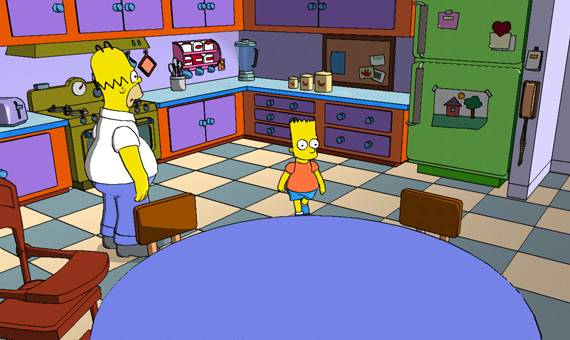
Feel free to wander around the house. The camera angles that greet you will have you heading for the front door in no time.

Unfortunately, because the Simpsons were one of the preeminent franchises of the 90s, and, while diminished, remain a strong force to this day, the pressure to flood the market with all sorts of dolls, games, toys, etc regardless of quality happened all too fast. Soon Nintendo titles hinged on such flimsy ideas as Bartman, Virtual Bart, and the Treehouse of Horror episodes. And let's not even talk about Bart Vs. The World. But things have changed, EA has now been entrusted with the house that Matt Groening built, and put their hefty pocketbooks behind a truly new adventure for Homer and the gang, a belated tie-in to the also quite self-explanatory film The Simpsons Movie.

Let's start with what shouldn't surprise us, from our past dealings with EA and The Simpsons. As par usual, EA has more than sufficiently flooded the project with cash, and got Groening's staff to provide the game with over forty five minutes of animation, on par with that of the tv show, as well as scribing the tale itself. The collaboration between the two powerhouses is more than evident, from the voice acting to the frighteningly perfect reproduction of Springfield, to the more than frequent references to obscure episodes (like Mr. Sparkle, for example). The next-gen visuals are at a point where they rival the look of the animated show itself. More or less, EA's got the presentation down pat, and taken great care to bring all of the aspects of The Simpsons to fruition in the title.

Here Bart and Lisa take on the logging efforts of Mr. Burns, and to paraphrase a certain South Park quote, "The Simpsons did it...already."

What's surprising (and by surprising, I mean "bad" surprising) begins first with the story. Instead of perhaps honing in on a specific person/aspect of the Simpsons universe, like most episodes do, or portioning the game into episodic self-contained bursts, The Simpsons Game has taken a new approach. Specifically, the Simpsons family is self-aware that they're in a video game; they find the manual to discover their moves, and look up a walkthrough on the Internet to discover what to do next. Isn't that funny? I mean, doesn't it have you in fits? Oh look, Will Wright and Matt Groening are in the game as themselves!!! Don't you love how they're self-consciously aware how stupid the idea of key cards are?

Is it funny, or sad? If one beats others in pointing out his/her own flaws does that forgive them in the first place?

While some games have truly been funny in their self-referential nature on gaming (like the funny, albeit flawed Eat Lead starring Max Hazzard) this smacks of an incessant self-conscious apology. As you go through the game, you'll be occasionally interrupted by the "Comic Book Guy" as he diminituively points out that you've once again encountered/enacted/found a "video game cliche," of which there are 31 to discover throughout the game. They vary from the protagonist not being able to swim, to the traditional pressure panels that require both party members, to the ubiquitous breakable crate. If these were mechanics were "one-liners" that we could dispense with after hearing, perhaps they'd be, dare-I-say-it, comical. But the truth is that these very elements they joke about are ever present and make up the majority of the gameplay.

The feebleness of the gameplay is masked by the ability to switch between the nuclear characters of the Simpsons family; freely in the hub world, and between the two pre-designated characters within the levels. Lots of characters mean lots of abilities and moves, right? Sure, if you're up for some fairly mundane abilities spread across four characters. Bart can glide with a Bartman cape, grapple to certain objects, and use zip-lines. That's right, you'll be familiar with Bart's "special powers" if you've encountered a ropes course at summer camp. Homer can burp on people to stun them, and roll around as a rotund version of himself. Lisa can play her sax loud enough...to stun people...and can pick up large objects with the power of...*sigh*...Buddhism. Marge can use a megaphone to...*yawn*...stun people, and can order crowds together to attack things. Many games would be completely comfortable with giving a singular playable character in a game this many abilities, were they not so trite and shallow, but the mediocrity is spread out in this one.

Bart can climb vines. Because, apparently, nobody else can. And, because, apparently, a cape and a mask easily assist one in said process. Ughh...sigh.

Most levels involve running around, finding collectibles to open doors, or breaking down a certain set of structures, or defeating a certain amount of enemies. Boss battles have a "rinse repeat" nature to them, once you've figured out the "secret" or "weak point" it is literally only a minute or two before you'll have destroyed it. And this begs a question: If a game is self-aware of its mediocrity in gameplay, or the over utilized tropes it plays around with, do we approach it with the same stance we would a game rushed to production, hoping its mediocrity will only be discovered once the shrink wrap and security tags are shed?

It provides us with another question as well: Is The Simpsons Game, in actuality, a game? With gameplay that is mindnumbingly repetitive (which is not to say that this is incapable of being enjoyed, aka, Marvel: Ultimate Alliance) and virtually no penality for death, along with perpetual solutions to already frighteningly easy puzzles provided in thought bubbles above the character's heads, are we actually playing a game? Or are we being pushed through a linear series of events, with an engineered impossibility of failure? Is this a predecessor to the recent eye candy that was Prince of Persia?

...speaking of the great choice-less adventure...

While the abovementioned paragraph seems to be littered with a handful of rhetorical questions, the answer to most is a resounding "Yes," and this appears to be a recent trend in the transformation of popular franchises into video games: basic, yet uncomplicated games, with basically no learning curve, and hardly any penalty for death, based on a preconstructed graphical engine. It's a "Choose Your Own Adventure" with the poor options taken out. You're given an accurate presentation of the desired franchise, and a storyline to match such, with no chance of not completing it.

While the review has taken a bit of a macroscopic stance on the implications of games that share a resemblance to The Simpsons Game, allow me to recap. The Simpsons Game is a well produced, and heavily funded title that relies more on fans "getting" soundbite references and meeting bit characters from the tv program, rather than focusing on innovative gameplay and/or an enjoyable story in line with the show. The storyline is too caught up in itself, and the subtlety of the show's humor (which was never that subtle) is completely lost with its meta-narrative. If you want a good looking Simpsons platformer riddled with basic fetch quests and a camera that will give you fits, the already low price should already encourage a purchase. If you simply have a Simpsons itch that you need to Scratch-y, you'd do better to simply get your hands on one of the earlier seasons on DVD.

Overall score 6/10
Good graphics and presentation
Bad Camera
Barely passable story
Poor gameplay

Wednesday, August 12, 2009

Whater ya playin'?

Welcome to what will likely be the first and only installment in the "Whater ya playin'" series. If that title seems odd...just imagine the merchant from Resident Evil 4 saying it. And if you haven't played Resident Evil 4, begone with thee!!! *Beckons toward the door* If you're wondering just what goes on in this series, the pithy statement "it is what it is" comes to mind. Leaning more towards the "stream of thought" style blogging is more known for, I'm simply going to write just what I've been playing lately, why I'm playing it, if I plan to keep playing it, and how I feel about it in general. This may branch out to sentiments regarding gaming in general, but I'm not certain at this point.

*Looking back over the past paragraph* Well, while that somewhat reeks of self-indulgence and a heightened level of self-importance, I'm going through with it. The last thing I want to add to that list is to have the qualities of a "quitter" as well.

What have I been playing, exactly? I've been occasionally dabbling in The Secret of Monkey Island: SE, for Xbox Live. Why do I say occasionally, you wonder (or not...if you happen to have a life that can successfully revolve and exist outside of knowing my every move). Because apparently you HAVE to have online access wherever you desire to play the game, as it requires logging into Xbox Live. I understand why, like, I totally get it. But that doesn't mean that it isn't a pain. I don't have any of the ethernet ports in my room, and I didn't shell out whatever ungodly amount for that expensive wi-fi receiver. That being said, I can only play when I'm at a friend's house. Perhaps it would be less of an issue if I actually had LIVE, but because I actually get my ass out of my house, I play with other people.

The only true "Secret of Monkey Island" is that you're going to need to have LIVE to download it...and to unlock it every time you play it.

Minor ranting aside, The Secret of Monkey Island is a perfect port of the original Lucasarts PC title. Well...it can be. You have the option at ANY time of freely switching between the original game and the HD makeover that its received. Please note the word "makeover." While this old boat's been given a new coat of paint, the gameplay, the puzzles, the dialogue, the storyline, all of it is intact...and untrammeled by developers that would be tempted to tweak things. I'll get into it more in a full scale review, but its safe to say this this, for ten dollars, is a bit of a steal. One of the best adventure games ever, intact in its original format, as well as the new look, and with all the dialogue fully voice, with the cast of The Curse of Monkey Island nonetheless.

There's just a much more epic sense of scale and teamwork in Gearbox's title. Not to mention that one actually begins to care about their ally compatriots. Something that CoD and MoH have never been quite capable of capturing.

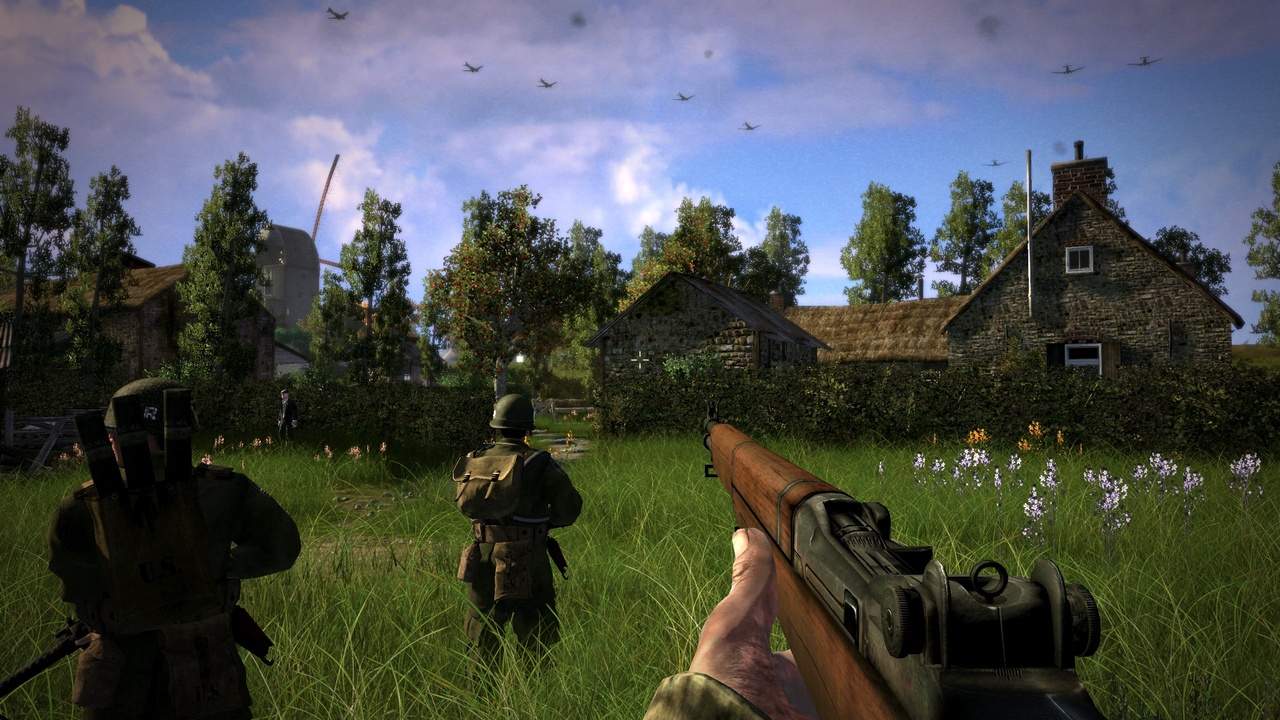
Other than that, I've been dabbling around with a much more large-scale, yet linear title: Brothers in Arms: Hell's Highway. If you haven't heard of it, the sheer flooding of the shooter market between the Medal of Honor and Call of Duty series have left little room for other series to inventively enter the genre. What I'm getting at is that there have been a couple affordable alternatives that are vastly inferior to the aforementioned franchises, but none have offered anything other than a poorly emulated experience, and most importantly, addressed the gaps and flaws that these two have presented. Specifically, Brothers in Arms offers an amazing story that isn't afraid to focus on the exploits of a single battalion/correct name for group of soldiers led by Matt Baker. You'll connect with each one of your squadmates, learn their fears and dreams, and see the effects of war on individuals even when they're not being peltered with mortar fire.

The gameplay is a bit of WWII meets Gears of War, with the grenade and cover mechanics looking eerily familiar. However, I find the cover system here to work a bit better, and is generally more responsive. The graphical engine is quite good, utilizing a modified variation of the Unreal Engine 3, and provides a semi-cartoonish/exaggerated style to the characters, making it easier to distungish who's who. The only problem I've encountered so far is that the story's strength hinges on one's knowledge of the two previous installments in the series. Apparently I'm visited several times by a ghost (or have nightmares of such, I'm not entirely sure WHAT he is at this point) of a long dead squadmate, but the importance of such relies on the knowledge of this character in previous games.

What's on the horizon? Looking at starting up Bionic Commando and maybe a couple rounds of Sid Meier's Civilization. But, more importantly, what are you playing?

Thursday, August 6, 2009

Battlefield Bad Company--A Review

Summary in a sentence: EA's D.I.C.E studios makes a remarkably competent foray into "single player campaign-land" with its new title, sporting a remarkable appetite for open-ended destruction...with a brand spankin' new graphical engine to boot.

During the summer of 2008, Electronic Arts bestowed upon a parched populous of gamers two seemingly similar titles. Indeed, it requires little imaginative skill to realize that Mercenaries 2 and Battlefield: Bad Company have a common upbringing in the "visit foreign country...get betrayed...seek revenge amidst a civil war, all while attempting to profiteer for one's own self off of said chaos and senseless destruction" genre. If this genre never truly catches on, I'll attribute it to the title of it. As it is in the crapshoot that is the video game industry, one turned out to be remarkably good, and the other...so-so. What's altogether surprising is that this conclusion turned the notion of "pedigree" on its head. Provided the notion of pedigree has a head. Or a metaphorical head.

The bottom line is that Mercenaries 2, the sequel to one of the very few "GTA clones...but not exactly GTA clones" to make a name for itself other than "shameless shoddy emulation" was based on a fairly strong freshmen entry that, with a few minor flaws fixed, stood to stand in strong contention with long-running franchises. Battlefield:Bad Company came from a long series of games that, like the creepy second cousin you occasionally run into at family reunions, never managed to truly fit into the console realm of gaming. It was far too dedicated to online play as its main purpose, as well as banking on a solid PC mods community, and, in general, never mapped well to console controllers, or ported well to consoles, in general.

*Cue Zelda chest opening tune: da-na---NAAAAAAA!*

At this point I could continue to creatively weave a narrative that would continue to perpetuate this notion that Battlefield: Bad Company was taking on an Olympian sized quest to topple the evil regime that is the Mercenaries franchise, which would turn out to conveniently eat babies and use aerosol cans, not for utilitarian purposes, but to further the spread of global warming. However, you're clever readers, and have already discerned that Battlefield: Bad Company was the better title of the two. Without any further ado, let's break it down.

The narrative of Battlefield: Bad Company treads the line perfectly, neither providing the player with an overwrought and heavy-handed melodrama reeking with self-indulgence, nor leaving the player with a one sentence justification in the manual for just why the act of widespread destruction and mayhem is ensuing. And it runs something like this, you are a soldier in the US military named Preston Marlowe, and without elaborating too much, you've happened to do something that doesn't go over well with the military-industrial complex. And rather than expel you, or perhaps put you on trial (though the past has shown that this hardly means anything) the army has its own "Remedial Regiment" reserved for the less than...exemplary models of the US Army. Appropriately, this group is called "Bad (B for short) Company."

Joining you are Private Sweetwater, who happened to upload a virus into the military's computer network, Private Haggard, a pyromaniac with a southern drawl that happened to set alight a fairly large ammo dump, and Sarge, whose done nothing wrong but was told his term of service would be shortened if he commanded the regiment with a disturbingly high turnover. While on your first mission you come across a member of a private military organization called "The Legionnaires" who happens to pay its members in gold bars.

A little explosion never hurt anyone. That's why you'll be causing BIG ones in this game.

Haggard, lured by the sweet promise of 24kt wealth runs after the trucks of "The Legionnaires" and, technically, invades a neutral country. Not wanting to have to answer for Haggard's temporary lack of judgement, Sarge orders your regiment to give chase. Explosions, more explosions, and a bevy of explosions follow. Cutscenes hardly provide one with a lengthy exposition on US military tactics, but they do provide likeable banter between your squadmates, and while all of them seem to fall into fairly common war film archetypes, it's enjoyable nonetheless.

The gameplay is fairly conventional and builds on the mechanics of previous installments, as well as conventional FPSs. You're allowed to carry a primary weapon (shotgun, assault rifle, sniper rifle, etc) a secondary firearm (more or less, variations on the theme of "pistol") and a special inventory item. There are a few twists though.

All primary weapons (and all are "real" weapons, used by various worldwide military and police organizations) come with a secondary function (underbarrel grenade launchers, for example) or allow for the use of grenades. The inventory accessory is what really mixes things up though, and allows for a decent amount of tactical customization. Need something to take out small tanks and pockets of infantry? There's a GPS transmitter that can call in mortar strikes. Want something more adept to taking on more heavily armed vehicles? Pick up a device that calls in a laser guided bomb, controlled by the player as it drops through the sky. Aching to repair your smoking helicoptor? There's a universal repair tool that'll do the job. And, of course, C4 is available as another one of these "gadgets." But you can only carry one at a time, until given the opportunity to swap out.

You've got a flaming slag that used to be a personnel carrier, Sarge looking on, and Haggard hoisting quite the armament. Care to guess just what exactly happened?

Those not used to the Battlefield series will find a few surprising changes on the FPS conventions. For starters, there are no health packs, instead, you have a adrenaline-esque shot that you are free to inject yourself with at any point, which returns your health back to a reassuring 100. Sound like a "game-breaker?" It's not. Because in Battlefield you die one way. Fast and frequently. Yet when you die, and return to the most recently reached checkpoint, all of the vehicles, soldiers, and inanimate destruction you had laid waste to on your previous "life" will remain exactly that...dead. It's an odd feeling, to say the least, to instinctually expect a tank around a corner, only to find a smouldering mess. In the end, you might be asking just what all of these oddities add up to, and the reality is this: a highly fast-paced explosion-fest that has no problem literally throwing you right into the middle of a full-on war, without the endless frustration that would accompany an entirely realistic approach.

The visuals of Bad Company are competently handled by the Frostbite Engine, recently created by D.I.C.E studios, and allow for an unbelievable amount of action to take place, without slowing down the framerate a bit. Visual fidelity has not been compromised for sheer speed, though. The character models are well animated and a semi-exaggerated cartoony flair in their creation breathes life into what is otherwise the "already been there and done that" that is modern warfare. However, it must be said that aside from blowing entry point holes into the sides of buildings, and simply leveling things, a greater amount of "tactical chaos" would be appreciated.

"Or I'll huff...and I'll puff...and I'll...fuck it, let's just use the mounted grenade launcher."

The music is strikingly epic and adventuresome without, like the story, getting too full of itself. It's aware that it's a sandbox roam-around in search of treasure. Likewise, the voice actors take care to never present their roles as anything but that. Sarge is constantly peeved with the morons he's now taken charge of, Sweetwater comes across as the geeky intellectual that just happened to press the "ENTER" button at the wrong time, and Haggard...well...he's the idiot savant that has none of the qualities of the latter.

Think of it as the "Remote Control of Death." Just point, click, and instead of switching to Animal Planet, set loose a flurry of mortar strikes. Which is not to say that Animal Planet isn't exciting, but...

Overall, if you want an excellent modern warfare campaign with a very different mood and disposition than CoD4 this is it. If you were looking for D.I.C.E. to finally put a bearable and light story to its large-scale battles, this is that as well. Hell, if you're looking for a generally flat-out amazing, as well as affordable (20 dollars, mind you) title, and you aren't morally opposed to First Person Shooters, this is for you.